Cyber Resilience Leadership Forum 2026: Key outcomes and highlights

Updated: Apr 22
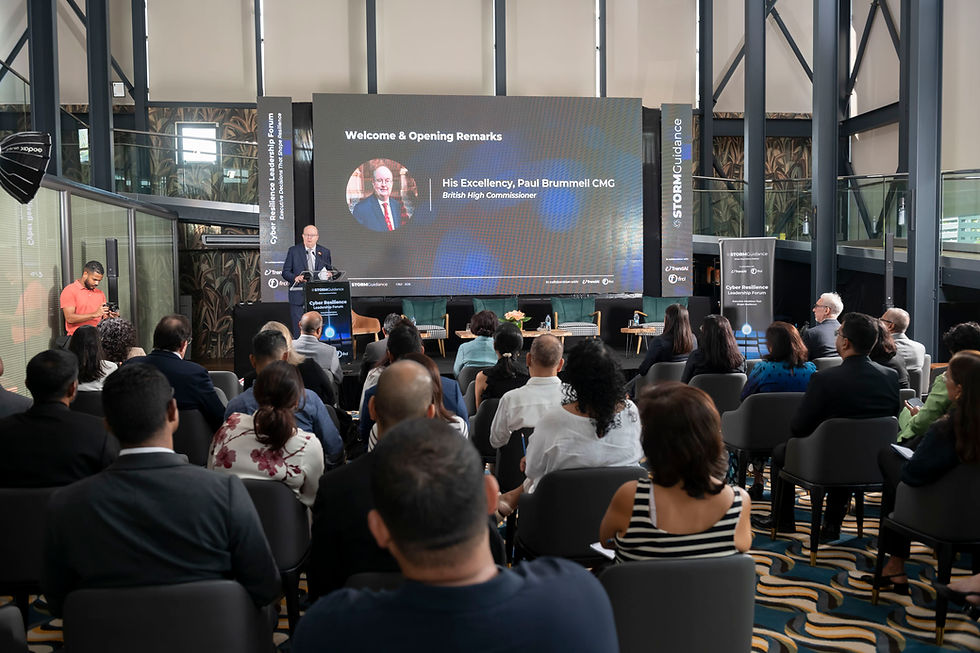
On 2 April 2026, STORM Guidance hosted the inaugural Cyber Resilience Leadership Forum (CRLF 2026) at Royal Green Wellness Resort, Moka.
In collaboration with TrendAI and FRCI, the forum brought together senior executives, regulators and specialists to focus on one message: cyber resilience is defined by executive decisions - before, during and after an incident.
Watch the video highlights
What CRLF 2026 set out to achieve
CRLF is designed as an annual leadership forum for decision‑makers-built to strengthen organisational resilience against the clear and present dangers of today’s cyber landscape.
The inaugural edition centred on practical, decision‑centric resilience: how leaders govern risk, manage AI‑driven exposure, and make defensible calls in the first hour of an incident without losing control of operations, reputation or stakeholder confidence.
For a roundup of the event press coverage, click here.
Opening and programme overview
His Excellency Mr Paul Brummell CMG, British High Commissioner to the Republic of Mauritius, opened the forum and formally launched CRLF as a new platform for executive dialogue on cyber resilience.
The programme then moved through an executive threat briefing, Panel 1 on national resilience and executive readiness, a live cyber incident simulation, and Panel 2 on the specialist disciplines required for effective incident response.
Key themes from the forum
Resilience is a leadership discipline: organisations fail or recover based on judgement, governance and speed of decision‑making - not only technical controls.
Real‑world reporting signals scale: CERT‑MU highlighted that 6,073 cyber incidents were reported on the MAUCORS+ platform in 2025-reinforcing the need for visibility, reporting discipline and coordinated readiness.
Preparedness must be evidenced: boards and executives need measurable readiness, not paper compliance.
AI is a risk multiplier: exposure spans fraud, impersonation and misinformation, and it increases the pace of incidents and escalation.
First‑hour decisions define outcomes: containment vs continuity, evidence preservation, stakeholder communications and regulatory notification must be handled with discipline.
Collective resilience matters: meaningful readiness requires coordination across regulators, critical sectors, and public‑private stakeholders.
Capability and talent shortages are real: specialist skills (technical, legal, communications, governance) remain a limiting factor in effective response.
"Resilience is no longer about how good your system is but how well leaders decide under pressure." Bizweek, Issue 587, 5 April 2026
Forum participation and engagement
Audience engagement was strong throughout the forum, with live questions submitted and interactive participation during the simulation.
Common themes raised by delegates included reporting discipline, board‑level metrics, third‑party exposure, crisis communications, and the practical realities of coordinating across legal, technical and executive stakeholders under time pressure.
Panel and speaker snapshot
Panel 1
This panel explored ‘National Resilience & Executive Readiness for 2026’ with perspectives spanning national cyber coordination, data protection governance, private‑sector readiness and executive accountability.
Panel 2
This panel focused on ‘The Specialism Required for Effective Incident Response’-highlighting why incident response is multidisciplinary by necessity (technical response, legal/regulatory duties, communications, and operational continuity).
“Plus de 6 000 cyberincidents signalés en 2025 à Maurice.” Le Défi Quotidien, 7 April 2026


